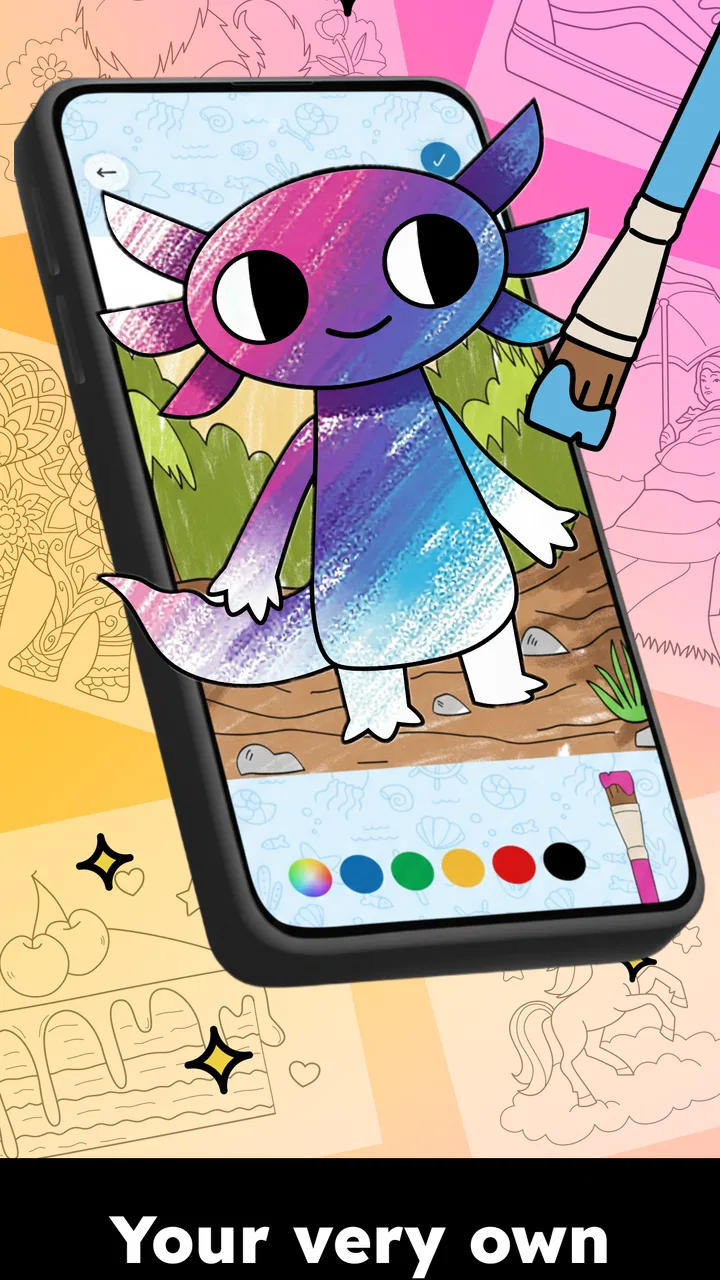
Aqua - Adobe for Kids
- 3.1
- Rating
- 100.00K
- Installs
- Free
- Price

 Analysis by App-foxy
Aqua - Adobe for Kids is an unusual entry in the education app space because its entire public identity is compressed into a simple idea: drawing and coloring. I spent time looking at it as a tool for children, families, and anyone who wants a low-pressure creative activity, and my impression is that its value depends less on advanced lessons than on how comfortably a child can approach the screen and begin making something. That makes clarity, patience, and ease of interaction more important here than a long list of educational claims.
Developed by Adobe, this free app sits in the education category and is suitable for everyone. It has passed the threshold of over one hundred thousand installs, while its average stands at 3.1 from roughly eight hundred ratings. That mixed score is worth keeping in mind: I would not treat Aqua as an automatic recommendation for every family, but I can see why it may appeal to children who enjoy visual play more than structured academic exercises.
The app is associated with a release date of June 15, 2026, and the version I reviewed is 26.08.26.2342. It requires Android 11 or later, so device compatibility is the first practical check before a child gets excited about using it. The short store description is simply “Aqua,” which tells you very little, so the real decision comes down to whether a straightforward coloring experience fits your child’s needs and your expectations.
You May Also Like

 Blood Strike: 2.5 Anniversary
Blood Strike’s Loadouts Turn Every Drop Into a Tactical Gamble
A close look at Blood Strike’s custom loadouts: how fast access to signature weapons reshapes its battle royale rhythm, rewards preparation, and narrows the gap between fights.

 Pandora - Music & Podcasts
Pandora’s Music Is Easy to Start, but Harder to Recover
Pandora’s strength is its low-effort path from a seed to a station. Its weak spot is how much confidence it asks you to place in connection, setup, and quiet recovery.

 8 Ball Pool
 Is Built on Rivalries, Rematches, and Routine
A close look at the rivalries, rematches, shared routines, and unanswered safety questions that turn a quick pool match into a persistent mobile community.

 Samsung Music
’s Quiet Strength Is Playing What You Already Own
Its reach comes less from spectacle than from dependable access to a personal library. That simplicity is both the app’s strongest retention engine and its ceiling.

 AccuWeather: Weather Radar
AccuWeather Review: A Quick, Clear Forecast for Everyday Decisions
For everyday plans, the best forecast is the one you can understand quickly. AccuWeather makes rain timing, radar, and local conditions easy to act on, with a few trade-offs.

 Hill Climb Racing
Why Hill Climb Racing Still Turns Crashes Into One More Run
A tiny car, a bumpy hill and one more upgrade: Hill Climb Racing keeps resurfacing because its simple chaos makes every near-miss feel personal.
More From Our News Desk



How Aqua works for different children and situations
I’d look at Aqua through the needs of the child who will use it, rather than assuming one drawing app suits every family. A child who wants relaxed coloring may need a very different setup from one who is still building touch control or finds bright screens tiring. I’d begin with a brief, shared tryout and notice what makes participation easier; that practical check leads naturally to the everyday situations where the app is most useful.
Readability and navigation come before creativity
With a children’s drawing app, the first few minutes matter. A child should be able to recognize where to start without needing an adult to explain a complicated sequence. Aqua’s appeal is strongest when the interface stays visually direct: the child can focus on the picture, the colors, and the act of drawing rather than on reading long instructions or learning a dense set of controls.
That simplicity can support children who are still developing reading confidence. It also helps when a parent wants to offer a quiet activity without turning it into a lesson. I would introduce it by sitting beside the child once, identifying the main drawing area, and then letting the child try. That small amount of guidance is more useful than assuming every child will understand a new creative interface immediately.
Readability is not only about the words on screen. It also includes whether buttons are visually distinct, whether the active tool is obvious, and whether a child can tell what changed after tapping. In a coloring workflow, unclear feedback can lead to accidental marks or repeated taps. For a child with attention difficulties, that kind of uncertainty may be more frustrating than the drawing itself.
My practical advice is to avoid presenting Aqua as a timed task. Let the child explore one picture or activity at a time, and watch for the point where the interface becomes tiring. A child who enjoys making marks may not want to navigate several screens before reaching the creative part. If the app keeps the path short, it is more welcoming; if it requires frequent adult intervention, its usefulness becomes more limited.
Motor control changes the experience
Drawing on a phone or tablet is not equally easy for every child. Small fingers, limited hand strength, tremors, reduced precision, or difficulty coordinating a finger with a visual target can all affect enjoyment. Aqua may work well for broad gestures and relaxed coloring, but I would not assume that every child will find touch drawing comfortable simply because the activity looks simple.
A larger tablet can make a meaningful difference. It gives the hand more room and reduces the need to keep a finger inside a narrow area. A stable surface is also helpful for children who press heavily or move the device while drawing. I would remove unnecessary pressure to stay inside a shape perfectly; the creative result should matter more than exact control.
One useful family workflow is to let the child choose colors and make the main marks while an adult handles any navigation that proves difficult. That keeps the child involved without turning motor challenges into a test. Another is to use short sessions with a pause between them. Repeated precise gestures can become tiring even when the child initially appears enthusiastic.
There is a trade-off here. A simple coloring app can feel less intimidating than a full digital art program, but simplicity does not automatically mean strong support for every motor ability. Children who need switch access, specialized input, or carefully adjustable touch behavior should be evaluated individually. I would test Aqua together rather than promising that it will solve those needs.
Sensory comfort is personal, not universal
Visual creativity can be calming for one child and overwhelming for another. Bright colors, repeated movement, busy screens, or the pressure to keep interacting may affect children with sensory sensitivities. I would begin with the device brightness at a comfortable level and use a quiet setting, especially if Aqua is being offered as a wind-down activity rather than an energetic play session.
The best use I found for this kind of app is controlled choice. Instead of handing over the device with no boundaries, I would offer a simple invitation: choose a picture, select a few colors, and stop whenever the activity no longer feels enjoyable. This gives the child an exit and avoids turning screen time into a struggle.
Parents should also observe whether the child is drawn to the visual task or merely tapping because the screen reacts. Those are different experiences. If the child becomes restless, squints, leans unusually close, or repeatedly abandons the activity, I would change the environment before deciding that the app itself is unsuitable. A larger screen, softer lighting, and fewer distractions can improve the session.
Aqua is also not a replacement for physical coloring materials. Paper offers texture, resistance, and a different kind of sensory feedback. For some children, that physical feedback is exactly what helps them stay engaged. I see the app as an additional option, particularly for travel or quick activities, rather than as a complete substitute for crayons, pencils, or paint.
Everyday situations where it makes sense
A realistic example is a family waiting at a medical appointment. A child may want something creative but may not have room for a pencil case or a sheet of paper. A drawing and coloring app can provide a compact activity, and the parent can keep the session short so it does not become disruptive. In that situation, Aqua’s education label matters less than its ability to offer a focused visual task.
It can also fit a quiet period after school, when a child wants to do something independently but is not ready for homework. I would avoid using it as a reward that must be earned every time, because that can make a relaxed creative activity feel like another performance. A better approach is to place it among several choices, including offline play.
For siblings, the experience may be uneven. One child may enjoy choosing colors while another wants more challenge, storytelling, or instruction. I would not expect Aqua alone to satisfy a mixed-age group for long. It is more successful when the adult understands what each child wants from the session and does not force everyone into the same activity.
It may also help a child who is hesitant about drawing on paper. Digital work can feel less permanent because the child is not worried about wasting a page. That can lower the emotional barrier to experimenting. At the same time, children who want to keep a physical portfolio may prefer traditional materials or a more advanced art app that offers a clearer creation workflow.
What it offers compared with familiar alternatives
Compared with paper coloring books, Aqua is more portable and easier to offer during travel. It avoids carrying supplies and can be started quickly. Paper remains better for tactile feedback, freehand practice without a glass surface, and activities that parents want to keep away from screens.
Compared with broad children’s learning platforms, Aqua appears more focused. That can be a strength for a child who becomes distracted by reading exercises, quizzes, or several unrelated game types. The trade-off is that it may provide less variety for families looking for phonics, mathematics, language practice, or a structured curriculum.
Compared with professional drawing software, it is the more approachable choice for a young beginner. A full art application can offer layers, brushes, and detailed control, but those tools can make the first experience feel like work. I would choose the advanced alternative for an older child who wants to develop technique, and Aqua for a child who mainly needs an inviting place to experiment.
The rating of 3.1 suggests that expectations should stay realistic. I would not download it assuming that the Adobe name guarantees a polished fit for every child or device. The developer gives the app credibility, but the actual question is personal: does this particular child find the interaction understandable, comfortable, and enjoyable?
Remaining barriers parents should notice
The Android requirement is an important practical barrier. If the family uses an older phone or tablet, the app may not be an option, regardless of how suitable the activity sounds. I would check the operating system before planning a trip or promising it as a new activity, particularly when the device belongs to a child and updates are controlled by an adult.
Another barrier is supervision. “Everyone” as a content rating makes the app broadly appropriate in age terms, but it does not mean every child can use it independently. A young child may still need help with navigation, choosing a comfortable session length, or recovering from an accidental action. Children with motor or sensory differences may need even more individualized support.
There is also the broader issue of screen dependence. A child may quickly prefer a device because it responds instantly and does not require cleaning up. I would set expectations before opening Aqua: it is one activity, not an unlimited replacement for outdoor play, conversation, books, or hands-on art. This matters especially when the app is used during transitions, because stopping can be harder if the child has not been given a clear endpoint.
I would also be cautious about using it for formal progress tracking. Coloring can encourage choice, attention, and hand movement, but those benefits should not be confused with a complete developmental program. If a teacher, therapist, or parent is working toward a specific goal, Aqua may be a supporting activity rather than the main tool.
My inclusive verdict
I see Aqua - Adobe for Kids as a modest, approachable creative app rather than a complete educational solution. Its strongest audience is a child who enjoys visual activities, benefits from a low-pressure starting point, and can use a compatible Android device with reasonable comfort. The free price makes trying it straightforward, and the everyone rating makes it easy to consider for a family setting.
The right test is not whether every child can open Aqua, but whether each child can participate in it comfortably and meaningfully. I would try it on the largest suitable screen available, stay nearby for the first session, reduce visual and environmental distractions, and let the child decide when enough is enough. Those steps reveal more than the app’s category label or a quick glance at its store page.
I would recommend it to families wanting a simple digital coloring option for travel, quiet time, or an introduction to screen-based drawing. I would skip it when the child needs a structured academic curriculum, advanced art tools, tactile learning, or specialized accessibility support that has not been personally tested. In those cases, paper materials, a broader learning app, professional drawing software, or an activity chosen with a specialist may be a better match.
In my experience, Aqua’s promise is narrow but understandable: give children a place to draw and color without making the activity feel like homework. That can be enough for a short, pleasant session. Just approach it as a flexible creative choice, not as a universal answer for learning, accessibility, or independent play.
FAQs for Aqua - Adobe for Kids
01What is Aqua - Adobe for Kids, and who is it designed for?
Aqua - Adobe for Kids is an educational and creative app intended to introduce children to digital art, drawing, colors, and basic design concepts in a friendly environment. Its interface is generally aimed at younger users, with simple tools and visual controls that are easier for children to understand. Parents should still check the recommended age range, available activities, and device compatibility before downloading.
02Is Aqua - Adobe for Kids free to download and use?
The app may be available to download without an upfront charge, but some features, lessons, creative tools, or additional content could depend on the current version and platform. Before installing, parents should review the Google Play or App Store listing carefully for in-app purchases, subscriptions, advertisements, and trial conditions. Store pricing and included features can change, so checking the official listing is the safest option.
03Does Aqua - Adobe for Kids require an internet connection?
Internet requirements can vary depending on how the app delivers lessons, artwork resources, account services, or updates. Some activities may work offline after installation, while other features could require a connection to load content or synchronize progress. If the app is intended for travel or use by children without constant connectivity, test the main activities first and confirm its offline behavior on your specific device.
04Is Aqua - Adobe for Kids safe for children to use?
Aqua - Adobe for Kids appears to be designed with children in mind, but parents should not rely only on the app’s name or visual style when evaluating safety. Review its privacy policy, permissions, advertising practices, account requirements, and any communication or sharing features. It is also advisable to enable parental controls, supervise younger children initially, and prevent unauthorized purchases through the device’s settings.
05Which devices are compatible with Aqua - Adobe for Kids?
Compatibility depends on the operating system, device model, available storage, and the minimum software version required by the current release. Before downloading, check the official Google Play or App Store page for supported Android or iOS versions and any tablet-specific requirements. Older devices may install the app but provide a slower experience, reduced performance, or limited access to certain creative features.
Pros
- Simple drawing tools are easy for young children to understand.
- Coloring activities can encourage creativity and independent play.
- Bright visuals make the interface appealing to children.
- Suitable for short
- relaxed creative sessions without complex rules.
- Can help children practice basic touch and hand-eye coordination.
Cons
- Some features may feel too basic for older children.
- Creative options may be limited compared with full drawing apps.
- Children may need adult help when first navigating the app.
- Extended use can contribute to screen-time concerns.
- Device compatibility and performance may vary across older phones.

Aqua - Adobe for Kids
Gallery